
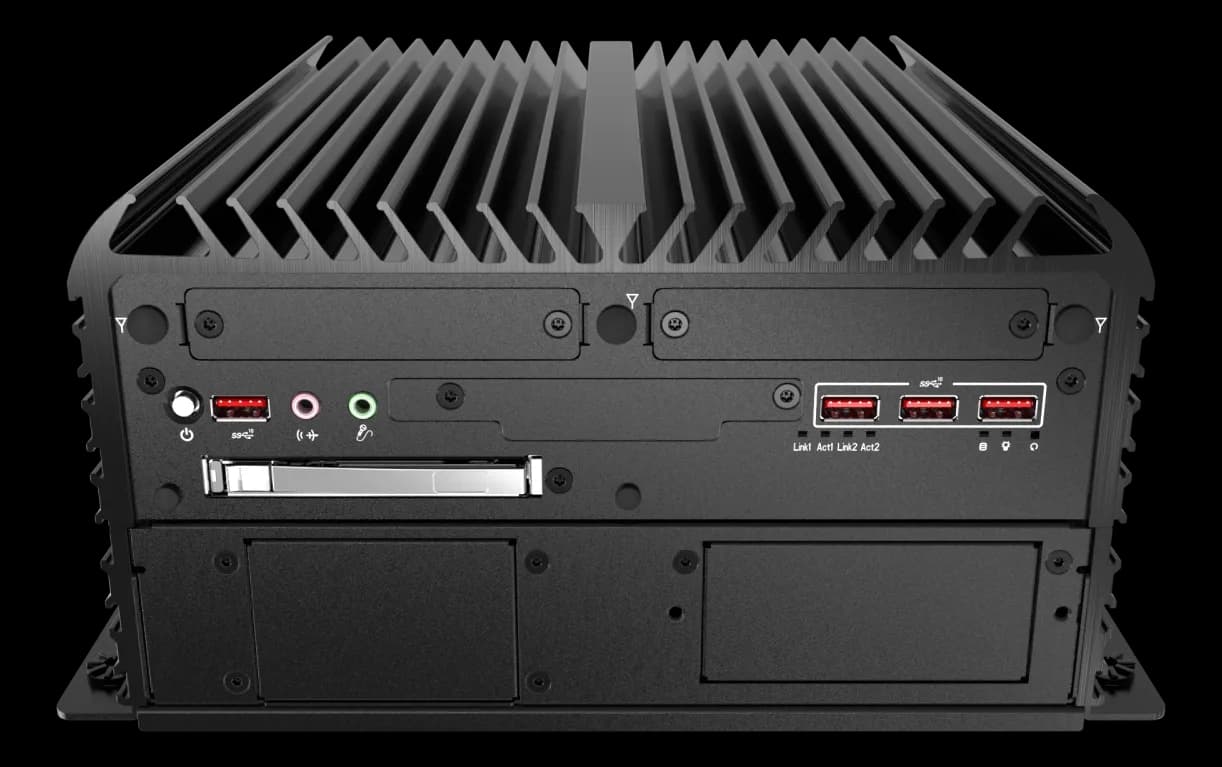
RCO-6000-RPL-2-2PWRFanless embedded computer for Edge AI inference, Intel Core 12th/13th gen
- Manufacturer

- Configurations
- 4 available configurations
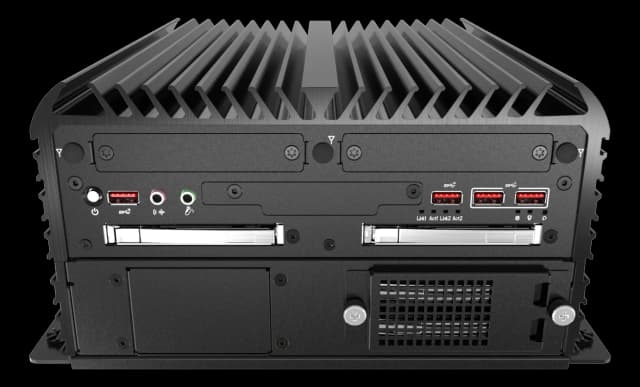
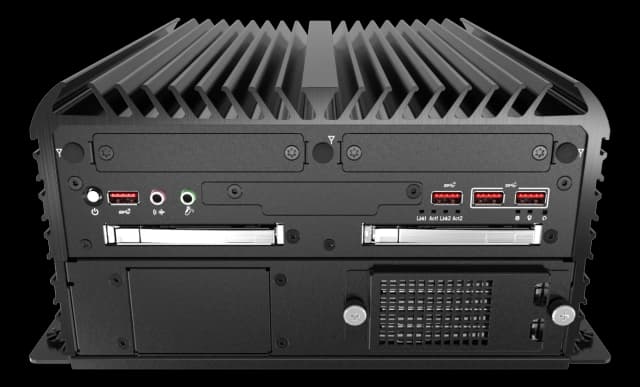
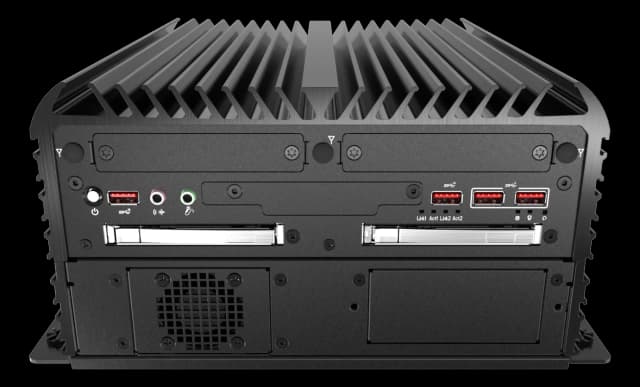
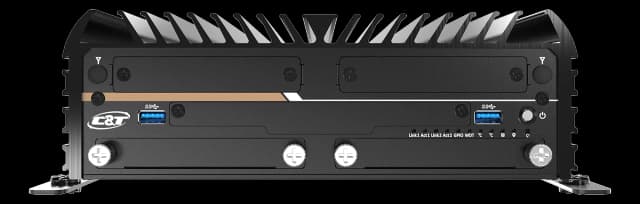
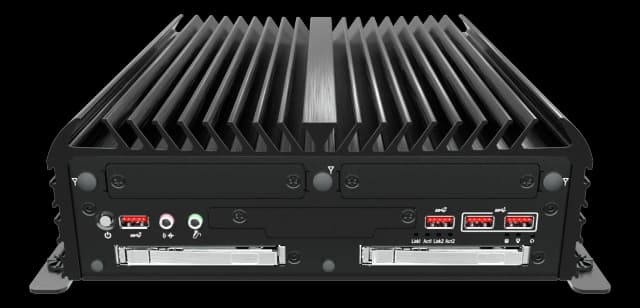
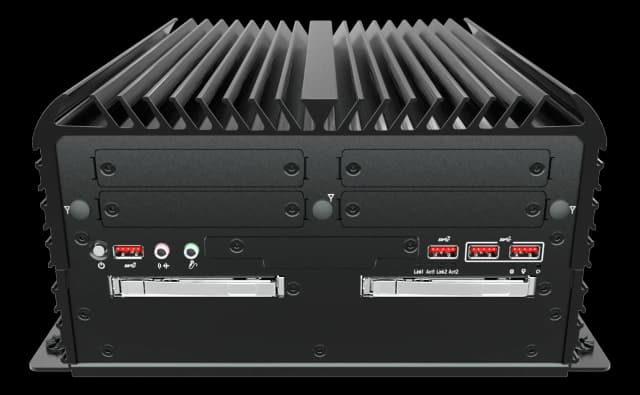
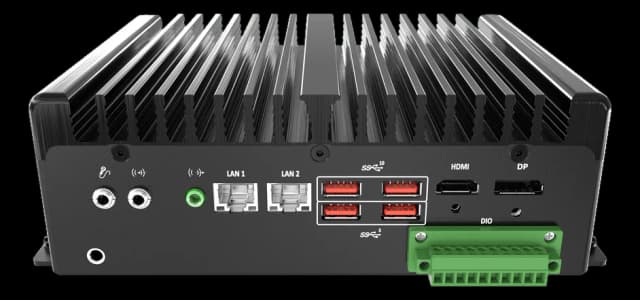
RCO-6000-RPL-2-2PWR is the AI inference system of the RCO-6000 series designed for fixed industrial installations: extruded aluminium chassis with heavy duty metal, fanless cooling, wall mounting and Windows or Linux operating system.
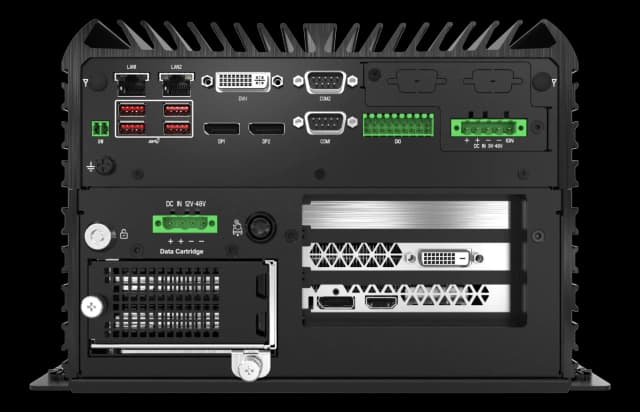
It stands out for its EDGEBoost expansion architecture: a reconfigurable PCIe node and two EDGEBoost I/O brackets on Mini PCIe interface, alongside Power Ignition Management on the two power inputs and a hot-swap SATA SSD bay with RAID 0 and 1.
Available configurations: RCO-6000-RPL-2E16-2PWR with 1x PCIe x16 (Gen 4) and 1x PCIe x1 (Gen 3), RCO-6000-RPL-2E8-2PWR with 1x PCIe x16 (8-lane, Gen 4) and 1x PCIe x8 (8-lane, Gen 4); the RCO-6000-RPL-2E16-2PWR-P and RCO-6000-RPL-2E8-2PWR-P versions are supplied with power supply.
At a glance
- Supports up to 3 Hailo-8 modules
- Power input 12–48 VDC
- Optional NVIDIA RTX A1000 8GB GPU
- DDR5 SODIMM expandable up to 96 GB
- Shock and vibration per MIL-STD-810H
Technical specifications
| CPU generation | 12th gen (Alder Lake)13th gen (Raptor Lake) |
|---|---|
| Processor | Intel® Core™ i5-12500TE, 35W(optional)Intel® Core™ i5-13500TE, 35W(optional)Intel® Core™ i7-12700TE, 35W(optional)Intel® Core™ i7-13700TE, 35W(optional) |
| Chipset | R680E |
| Graphics | Intel® UHD Graphics 770/710 |
| AI module | Hailo-8 |
| Memory | 2× SODIMM DDR5 262-pin 4800/5600 MT/s |
|---|---|
| RAM type | DDR5 |
| Maximum RAM | 96 GB |
| ECC support | (ECC and Non-ECC) |
| Storage | 1x 7mm 2.5" SATA HDD Bay (Hot-swappable)(optional)1x 9mm 2.5" SATA HDD Bay (Internal)(optional)1x M.2 B Key, 2242/3042/3052(optional)1x mSATA (Shared by 1x Mini PCI Express)(optional) |
|---|
| Number of displays | 3 |
|---|---|
| Video outputs | 2× DisplayPort 1.4a, Support resolution 5120× 32001× DVI-I, support resolution 1920× 1200 |
| Ethernet ports | 2.5 GbE1: Intel I226, 2.5 GbE2: Intel I226 · Support Wake-on-LAN and PXE, Support TSN · 2× RJ45 |
|---|---|
| USB ports | 8× USB 3.2 Gen 2 (10 Gbps)1× USB 2.0 (Internal) |
| Serial interfaces | 2× RS-232/422/485 ; 4× RS-232/422/485 (Internal) |
| Audio | 1× Mic-in, 1× Line-out |
| Digital I/O | 8 in / 8 out (Isolated) |
| CAN bus | 2× CAN 2.0 A/B 2-pin Internal header |
| Wireless | 4G/LTE5GBluetooth(optional)Wi-Fi 6 (802.11ax)(optional) |
|---|
| Expansion | 1x Full-size Mini PCIe (1x shared by 1x mSATA)1x M.2 (E Key, PCIe x1, USB 2.0, 2230)1x PCIe x16 (8-lane, Gen 4), 1x PCIe x8 (8-lane, Gen 4)1x PCIe x16 (Gen 4), 1x PCIe x1 (Gen 3)4-port GbE module with Intel® I350 Chipset, RJ-45/M12 connector (PoE optional)1× M.2 B-Key, 2242 for AI/NVMe, 1× M.2 B-Key, 3042/3052 for 5G/AI/NVMe(optional)1× M.2 for 5G (B Key, PCIe x1, USB 3.0, 3042/3052), 2× SIM socket, 1× SIM switch(optional)1× M.2 M-Key, PCIe x4 Lane, 2242/2260 for AI Module/NVMe(optional)1× RJ45 port for OOB Management Module(optional)2-Port RJ45 10GbE with Intel X710 Chipset(optional)4-Port USB 3.0 (share PCIe Gen2 x1 bandwidth)(optional) |
|---|
| Supply voltage | 12–48 V |
|---|
| Mounting | Wall Mount |
|---|---|
| Dimensions | 240 (W) x 261 (D) x 126.8 (H) mm |
| Weight | 6.5–7.5 kg |
| Chassis material | Extruded Aluminum with Heavy Duty Metal |
| Operating temperature | -25–70 °C |
|---|---|
| Storage temperature | -30–85 °C |
| Certifications | CEIEC 62368-1ULFCC(class A) |
|---|
| Operating systems | LinuxWindows |
|---|
Data extracted from the manufacturers' technical sheets: the official product spec sheet remains the reference for final confirmation.
Family configurations
The order codes of this family: the sheet applies to all of them, the detail of each configuration is in the datasheet.
| Configuration (PN) |
|---|
| RCO-6000-RPL-2E16-2PWR |
| RCO-6000-RPL-2E16-2PWR-P |
| RCO-6000-RPL-2E8-2PWR |
| RCO-6000-RPL-2E8-2PWR-P |
Documentation
In the same family
More products from the same series: select up to 3 and compare them side by side.
In the same category
Let's talk about your project
Phone and email go straight to our technical sales team in Turin: the first answer is already a technical one.