
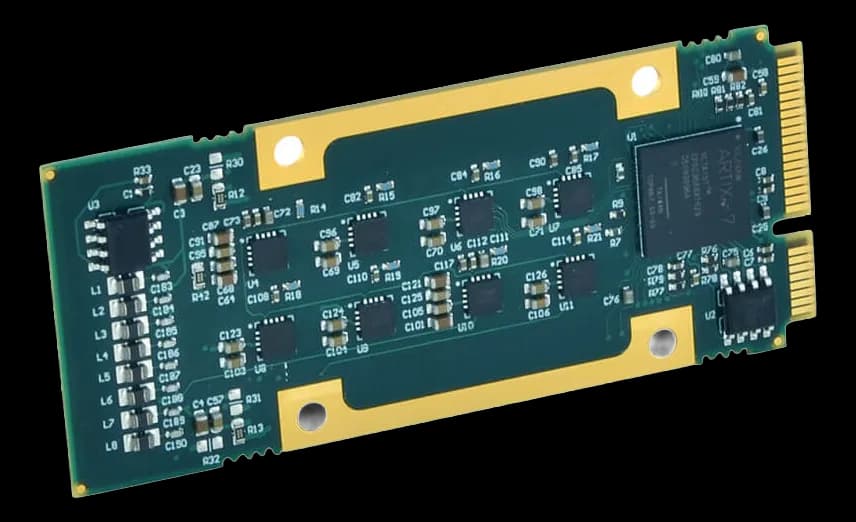
AP231AcroPack analog output mezzanine module with 16-bit DAC per channel
- Manufacturer

- Configurations
- 1 available configurations
The AP231 is an AcroPack mezzanine module that brings Industry Pack I/O to a PCIe interface while keeping the memory map and functionality in a rugged form factor. It is a COTS board for defense, aerospace, automation and laboratories: on a carrier hosting two AP modules you get up to 32 voltage outputs from a single card cage slot.
Each channel has its own D/A converter, so the glitches typical of the sample-and-hold reacquisition used in multiplexed output boards do not appear. Via software you can read the status of each output and the alarm function for brownout, short circuit and temperature above 150 °C.
Available configuration: AP231-16E-LF, 16 voltage outputs with 16-bit DAC.
At a glance
- Six output ranges software selectable
- Double-buffered data latch on every channel
- Outputs at 0 volts on reset
- Calibration coefficients stored on board
- Linux, Windows and VxWorks support
Technical specifications
| FPGA / processing | Xilinx® Art ix-7 |
|---|
| Channels | 16 |
|---|---|
| Acquisition specifications | 6 independent software selectable output ranges plus capabilities to monitor the status of each output |
| DAC resolution | 16 bit |
| Board function | Analog generation (output only)Analog and digital I/O |
|---|---|
| Bus interface | PCI Express Generation 1 interface |
| Dimensions | Length 70mm - Width 30mm |
|---|
| Operating temperature | -40–70 °C |
|---|
| Certifications | RoHS |
|---|
| Operating systems | LinuxVxWorksWindows |
|---|
Data extracted from the manufacturers' technical sheets: the official product spec sheet remains the reference for final confirmation.
Family configurations
The order codes of this family: the sheet applies to all of them, the detail of each configuration is in the datasheet.
| Configuration (PN) |
|---|
| AP231-16E-LF |
Documentation
In the same category
Let's talk about your project
Phone and email go straight to our technical sales team in Turin: the first answer is already a technical one.