
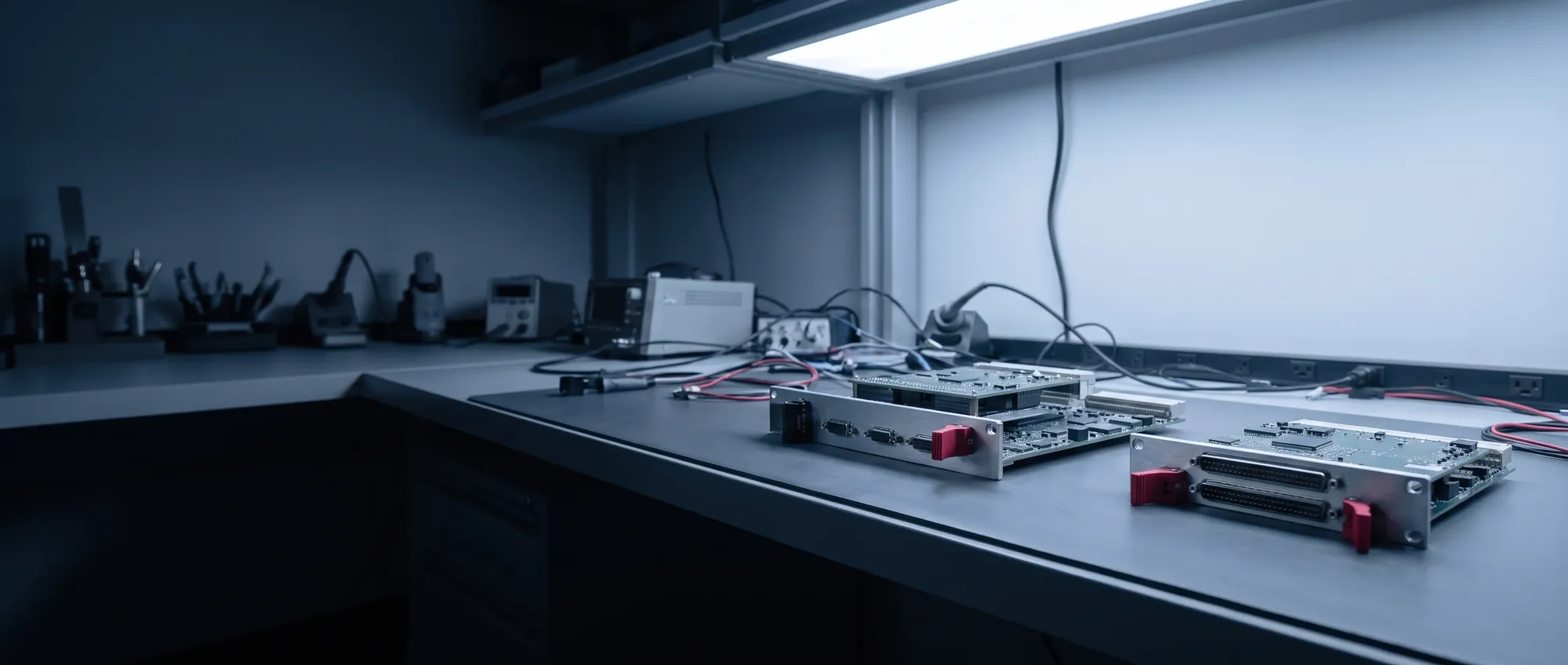
The PMC and XMC architectures, explained
The mezzanine that adds functions to the host board: PMC combines PCI electricals with CMC mechanics; XMC adds the serial fabrics of VITA 42. Here you find formats, connectors and where the catalog starts.
What a mezzanine is: the board's raised floor
A PCI Mezzanine Card is a board built to IEEE P1386.1: PCI bus electricals on Common Mezzanine Card mechanics, mounted in parallel above the host board via connectors and standoffs.
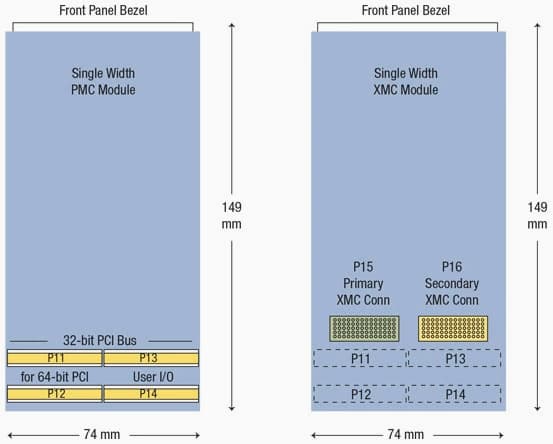
Like a building's mezzanine floor, the PMC fits between two adjacent boards in the rack: a single card measures 74×149 mm and uses up to four 64-pin connectors — P1 and P2 for 32-bit PCI, P3 for 64-bit, P4 for user I/O — plus optional front-panel (bezel) connectors. The result: PCI compatibility in a smaller, more rugged package than desktop plug-in cards. Carriers come in Eurocard formats: VME, CompactPCI and, more recently, VPX — one PMC on 3U, up to two on 6U.
XMC is the VITA 42 evolution: it keeps PMC mechanics and adds the high-speed differential connectors P15 and P16 — 114 pins each, 20 differential pairs — for serial fabrics independent of PCI: PCI Express (42.3), Serial RapidIO (42.2) and other "dot" specs. PCI and fabrics can coexist on the same mezzanine, or either can be used alone.
The service: custom platforms and microracks How the engineering team works
What the specification says
The family, item by item
The PCI base, the serial evolution and the footprints.3 entries
PMC · IEEE 1386.1
PCI on CMC mechanics
It defines which pins carry which PCI signals and reserves P4's 64 pins for arbitrary I/O. The double format exists but is rare; the 1 mm connectors withstand shock and vibration better than a card edge.
XMC · VITA 42
Serial fabrics · dot specs
The 42.0 base defines mechanics and connectors; the "dots" map protocols: 42.1 Parallel RapidIO, 42.2 Serial RapidIO, 42.3 PCI Express, 42.4 HyperTransport, 42.5 Aurora, 42.10 general purpose I/O. The Samtec connectors are rated for 900 insertion cycles.
Footprint
Single · double · short
Single 74×149, double 149×149; short versions (139 mm) omit the PCI connectors. Power: up to ~100 W input, but air cooling in standard carriers handles ~15 W — beyond that, conduction takes over.
What a mezzanine carries
The catalog's real functional families: specialized I/O travels on mezzanines.1 tables
The catalog families
From the PMC and XMC modules category.
| Family | What it brings to the host |
|---|---|
| Avionics buses | ARINC 429, MIL-STD-1553, 10 Mbit 1553 |
| Analog and digital I/O | acquisition, counter/timers, motion control |
| FPGA | on-board processing and sensor processing |
| Communications | Ethernet and switches, serial, fieldbus |
| Graphics and storage | video compression, disks and memory |
The PMC/XMC catalog starts here
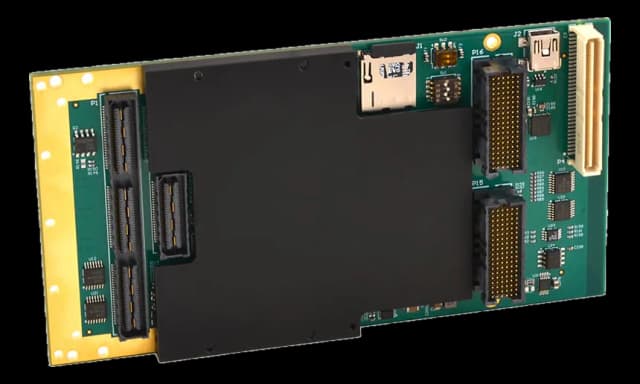
XMC modules
Where PMC and XMC work
Where specialized I/O — avionics first — is added to existing Eurocard systems.

Nearby architectures
The hosts that carry them and the next-generation mezzanines.

Let's talk about your project
Phone and email go straight to our technical sales team in Turin: the first answer is already a technical one.