
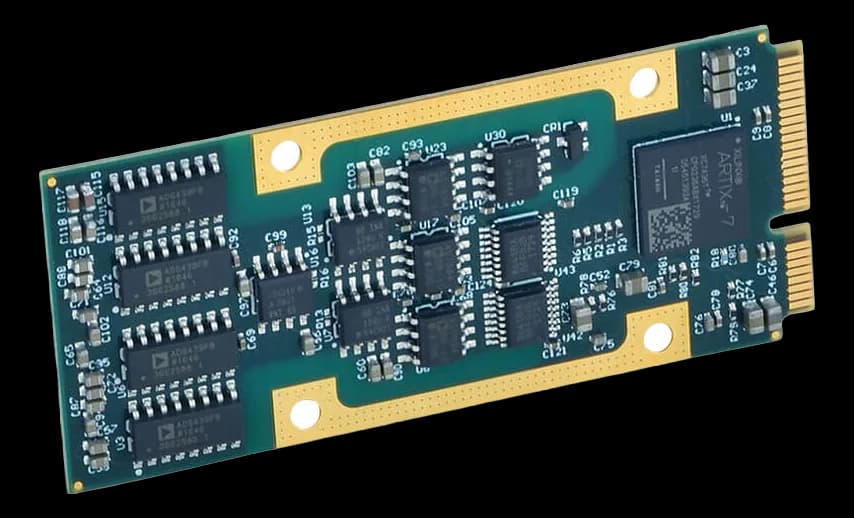
AP408AcroPack PCI Express module with 32 high-voltage digital I/O channels
- Manufacturer

AP408 brings the functions of Industry Pack modules to a PCI Express Generation 1 interface, with the same functionality and the same memory map: you move to the AcroPack format without changing how your software addresses the I/O. It is used to monitor or control the on/off state of field devices, mounted on an AcroPack carrier via a downward-facing 100-pin Samtec connector.
The outputs are fail-safe: off at power-up and automatically cleared after a software reset, not left in an undefined state. On each channel, input and output are connected in tandem, so loopback monitoring of critical signals is native: self-test and diagnosis of open output switches or short circuits.
The family is available in the AP408E-LF configuration.
At a glance
- Onboard Xilinx Artix-7 FPGA
- Programmable change-of-state or level interrupts
- TTL input threshold with hysteresis
- No output current derating at high temperature
- Footprint 70 x 30 mm
Technical specifications
| FPGA / processing | Xilinx® Artix-7 |
|---|
| Connectors | A down facing 100 pin Samtec connector will mate with the carrier card. Fifty of these signals are available as field I/O signals. |
|---|
| Channels | 32 |
|---|---|
| Digital I/O | 0 to 60V DC input range, 60V DC low-side switch outputs · Outputs sink up to 1A per channel · High impedanceIndividual outputs sink up to 1A DC continuous. No deration of output current required at elevated temperatures.TTL-compatible input threshold with hysteresis |
| Architecture standard | AcroPackPCI Express |
|---|---|
| Board function | Analog and digital I/O |
| Bus interface | PCI Express Generation 1 interface |
| Dimensions | 70 x 30 mm |
|---|
| Certifications | RoHS |
|---|
Data extracted from the manufacturers' technical sheets: the official product spec sheet remains the reference for final confirmation.
Documentation
In the same category

Let's talk about your project
Phone and email go straight to our technical sales team in Turin: the first answer is already a technical one.