Four codes, four different questions
In land defence and avionics specifications the MIL-STDs arrive as a group, as if they were steps on the same ladder. They are not: each answers a question the others do not touch.
MIL-STD-810asks how the equipment behaves in the environment: temperature, altitude, shock, vibration, sand, salt fog, humidity.MIL-STD-461asks how it behaves in the spectrum: how much it emits and how much it withstands, in emission and susceptibility, conducted and radiated.MIL-STD-704asks how it survives an aircraft's electrical power, which has its own characteristics, transients and interruptions.MIL-STD-1275asks the same question for the 28 V network of military vehicles, where the dominant disturbance is not the same thing as in flight.
Equipment can be tested to 810 and never have seen 461, and the other way round. Different reports, often different laboratories, very different costs.
MIL-STD-810 is not a certification
This is the sentence that saves the most time. MIL-STD-810 does not certify: it is a collection of test methods to be selected and tailored to the system's real usage profile. The standard itself says its methods are not applied to the letter but adapted — tailoring — to the life cycle environmental profile of the platform the equipment will serve.
It follows that "MIL-STD-810 compliant", on its own, is not information. It becomes information when it carries three things: which methods were run, with which procedure, and at which levels. Equipment tested for the vibration of a wheeled vehicle and equipment tested for that of a helicopter carry the same label and are not the same product.
At quotation stage the right question is not "is it 810?" but "which methods have a report, and at what levels?".
Power separates the vehicle from the aircraft
704 and 1275 look interchangeable because both talk about DC power, and they are nothing of the sort. They describe two on-board networks with different histories: the aircraft's, with its discipline of transients and interruptions, and the ground vehicle's, where engine cranking and inductive loads produce events that do not exist on an aircraft.
This is why a system designed for land does not fly by changing its connector: the power input is design, not an accessory. When a specification cites one or the other, it is choosing the platform before it chooses the function.
VITA 47, the same question in modular form
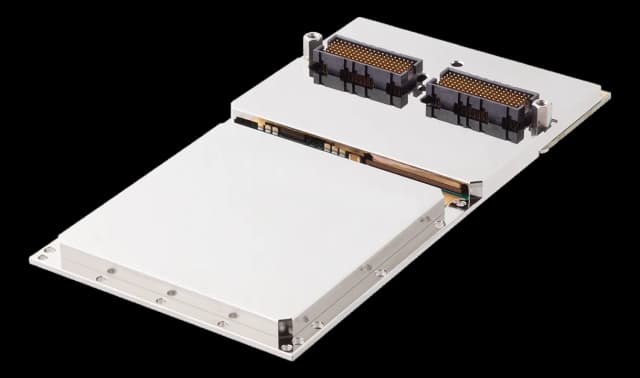
In the VITA board world the environmental question has its own answer: VITA 47 defines temperature and cooling classes for plug-in units, that is, for boards living inside a chassis. It does not replace 810 — which concerns the complete system — but it makes modules comparable, which is why it appears in VPX subsystem specifications before it appears in the system specification.
How this reads in the catalogue
The catalogue declares what the manufacturer declares, keeping the codes separate: it is the only way for the figure you read to mean something. The four rows below — plus VITA 47 — are live counts, read as the page loads.
The gap in scale between the first row and the last ones tells the market better than any comment: environmental qualification is widespread, on-board power qualification is a platform choice and concerns few products, almost always complete systems. When they appear together in a specification, the field narrows to build-to-specification — which is the trade next to the catalogue, not a fallback.