
SMARC
Future-ready, low-power ARM and x86, 15 W limit
82 × 50 mm
- 314-pin edge connector
- 4 PCIe lanes, max Gen4
- 4 video · 2× NBASE-T
- Up to 12 W typical
The PICMG Computer-on-Module standard for high-performance edge computing: from the 95 × 70 mm Mini form factor for Intel Core Ultra up to the edge server, PCIe Gen5 ready for Gen6. It extends COM Express, it does not replace it.
COM-HPC is the PICMG open standard for a family of high-performance Computer-on-Modules that, since revision 1.2, covers the whole range: from the 95 × 70 mm Mini to the edge server.
The reason for the new specification is concrete: digital transformation drives demand for high-bandwidth embedded computers, and COM Express's 440 pins are no longer enough — nor is its connector guaranteed to sustain PCIe generations beyond Gen 3. COM-HPC starts again from a 400-pin high-speed connector, designed for PCIe Gen5 with headroom for Gen6: up to 65 PCIe lanes, up to 8× 25 Gbps Ethernet KR interfaces, USB4.
Released in Q1 2021, COM-HPC extends COM Express without replacing it: the module requires a carrier board for I/O and power. It supports CPUs up to 150 W, up to 8 full-size DIMMs (1 TB), FPGAs and GPUs as PCIe targets, and ARM64 CPUs as well as x86.
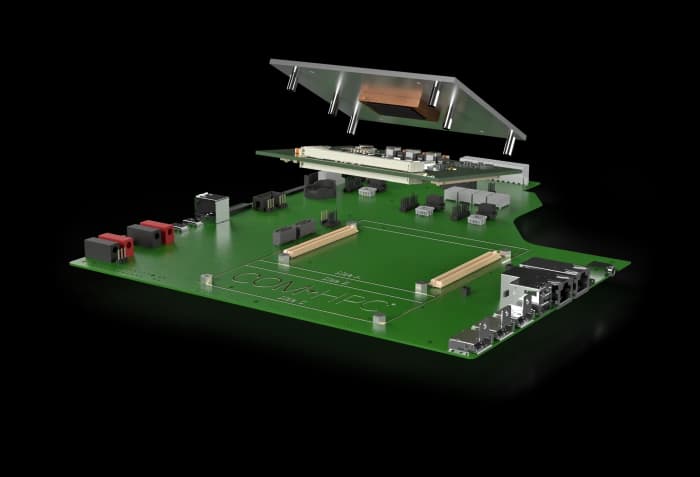
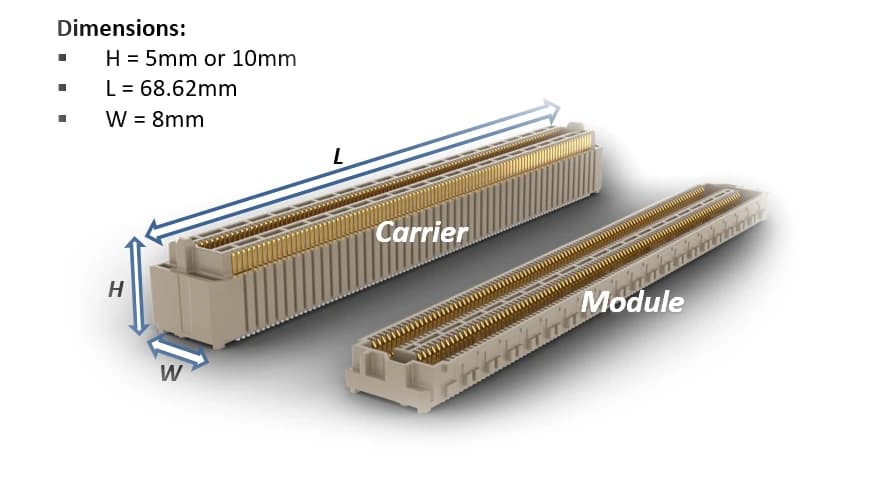
Revision 1.2 adds the Mini form factor alongside Client and Server: a single 400-pin connector and COM-HPC bandwidth on the new Intel Core Ultra SoCs with NPU. Pick a size to see it to scale; the dashed outline is a 125 × 95 mm COM Express Basic.
Three module types with pinouts optimized for different uses. Carriers are not interchangeable between types: choosing the type is the first design decision.
| MiniREV. 1.295 × 70 mm | Clientsizes A · B · C | Serversizes D · E | |
|---|---|---|---|
| Connectors | 1 × 400 pins | 2 × 400 pins | 2 × 400 pins |
| PCI Express | 16 lanes Gen5/Gen6 | 48 + 1 lanes Gen5/Gen6 | 64 + 1 lanes Gen5/Gen6 |
| Video | module-dependent | up to 4 (3× DDI + eDP) | headless |
| Ethernet | 2× NBASE-T, up to 10 Gb | 2× 25 Gb | 8× 25 Gb |
| USB | 4× USB 3.x or 2× USB4, 8× USB 2.0 | 4× USB4, 8× USB 2.0 | 2× USB4, 8× USB 2.0 |
| Memory | soldered LPDDR | SO-DIMM | up to 8 DIMMs, 1 TB |
| Typical power | module-dependent | ~100 W · max 251 W | ~180 W · max 358 W |
| Where | UAVs, portable and vehicle systems, vision | medical, T&M, rugged embedded, transportation | mission-critical servers, imaging, autonomous driving |
The comparison
The differences declared by the specification.
| COM-HPC | COM Express | |
|---|---|---|
| Module–carrier pins | 400 Mini · 800 Client e Server | max 440 |
| Connector bandwidth | 32 GT/s (≈3×) · PCIe Gen5, ready for Gen6 | PCIe Gen 3 (8 GT/s) |
| Memory | 8 full-size DIMMs (1 TB) + 4 SO-DIMMs · soldered LPDDR on the Mini | SO-DIMMs |
| CPU power | up to 150 W | up to ~80 W |
| Interfaces | 65 PCIe · 8× 25G KR · USB4 | 24–32 PCIe · GbE/10GbE · USB 3.x |
The sizes
One Mini size, three Client, two Server.
| Size | Dimensions | Type |
|---|---|---|
| Mini | 95 × 70 mm | Mini |
| A | 95 × 120 mm | Client |
| B | 120 × 120 mm | Client |
| C | 160 × 120 mm | Client |
| D | 160 × 160 mm | Server |
| E | 200 × 160 mm | Server |
| COM-HPC Mini1 × 400 pins | COM-HPC Client2 × 400 pins | COM-HPC Server2 × 400 pins | COM Express Type 62 × 220 pins | |
|---|---|---|---|---|
| PCI Express | 16 lanes Gen5/Gen6 | 49 lanes Gen5 | 65 lanes Gen5 | 24 lanes Gen3 |
| High-speed Ethernet | module-dependent | 2× 25 GbE KR | 8× 25 GbE KR | — |
| BASE-T Ethernet | 2× NBASE-T, up to 10 Gb | 2× up to 10 Gb | 1× up to 10 Gb | 1× Gigabit |
| Video | module-dependent | 3× DDI, 1× eDP | headless | 3× DDI, 1× LVDS/eDP |
| High-speed USB | 2× USB4 or 4× USB 3.x | 4× USB4 | 2× USB4 · 2× USB 3.2 | 4× USB 3.0 |
| USB 2.0 | 8× | 8× (4 paired with high-speed USB) | 8× (4 paired with high-speed USB) | 8× |
| Camera | up to 4× MIPI-CSI | 2× MIPI-CSI | — | — |
| Audio | module-dependent | 2× SoundWire, I²S | — | HDA |
| Storage | module-dependent | 2× SATA | 2× SATA | 4× SATA |
| System bus | module-dependent | eSPI, 2× SPI, SMB | eSPI, 2× SPI, SMB | SPI, I²C |
| Serial and GPIO | CAN bus | 2× I²C, 2× UART, 12× GPIO | 2× I²C, 2× UART, 12× GPIO | 2× SER/CAN, 8× GPIO/SDIO |
For years x86 Computer-on-Modules were built on a monolithic CPU plus PCH. With Meteor Lake — Core Ultra Series 1, December 2023 — Intel changes architecture: the processor becomes a tiled SoC with an integrated NPU that carries PCIe and USB4 on its own and draws between 15 and 28 W. COM Express was not designed to serve it; COM-HPC Mini was.
Before: monolithic CPU + PCH
From Meteor Lake: tiled SoC with NPU · 15–28 W
What a tile is. An independent silicon die: Meteor Lake places four side by side in the same package, instead of the single monolithic chip plus PCH of earlier generations.
Small-module footprint, COM-HPC interfaces. The Mini fills the gap between low-power modules and COM Express Compact, and it is the only one of the four without the Gen4 limit.
Future-ready, low-power ARM and x86, 15 W limit
82 × 50 mm
Mature, considered legacy in its class
84 × 55 mm
Ready up to PCIe Gen6, targeting Intel Core Ultra
95 × 70 mm
Solid mainstream, but stuck at Gen4
95 × 95 mm
Where space is scarce and reliability is not negotiable: the Mini brings high-end computing and AI into systems that used to choose between performance and size.
Onboard payloads and portable ground stations: tracking, mapping and real-time video on battery power.
weight · power · shock
Mission computers and compact consoles for vehicles and airborne platforms, where every litre of volume counts.
vibration · long life
Onboard signal processing and sensor fusion, with deterministic response and multiple operator displays.
bandwidth · latency · multi-display
Handheld terminals and medical devices with real-time OCR and vision, no cloud.
thickness · battery life · on-device AI
Cooling, development kit, management software and debug tools: the path from first prototype to qualified system is already mapped out.
Validated on Windows 11, Windows 10 LTSC and Ubuntu 24.04 LTS, with Yocto support. Monitoring of temperatures, voltages, fans and CPU load runs through SEMA, ADLINK's embedded management agent: open source on GitHub, licence-free.
The DB40-HPC port on the underside of the module takes the dedicated debug board: POST codes, BIOS and EC updates, power control. AMI UEFI BIOS and Infineon TPM 2.0 on board.
The module specification can be purchased from PICMG; the carrier design guide is a free download.
GOMA's engineering team starts from your specification and delivers the tested rugged system, from Mini to Server.
Where server-class computing lives inside an embedded system — and, with the Mini, where that computing must fit in a few centimetres: imaging, robotics, UAVs, industrial edge.
The Computer-on-Module family, from low power to server class.

Phone and email go straight to our technical sales team in Turin: the first answer is already a technical one.
New references in the catalogue, qualifications obtained and trade show dates. One email a month, no spam.