The onboard network starts at the connector
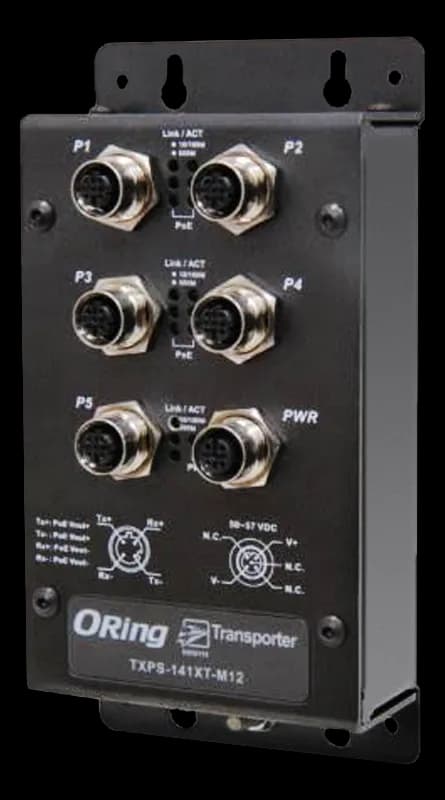
On a vehicle the problem is not bandwidth: it is vibration. TXPS-141XT-M12-MV uses M12 connectors, which screw in and do not come loose, and carries EN 50155 certification — the standard that covers electronic equipment installed on board railway vehicles. The weight is 0.771 kg, the dimensions are 88.9 × 178.2 × 55 mm.
Powering cameras, not just connecting them
The switch delivers PoE according to IEEE 802.3at with a 60 W budget: this is the allowance to account for when counting video surveillance cameras, access points and infotainment devices on the same node. The supported standards are IEEE 802.3, 802.3u, 802.3x and 802.3at; forwarding is store-and-forward. The device's own consumption is 5 W.
What the manufacturer declares
- Operating temperature: from -40 to 75 °C; storage from -40 to 85 °C
- Protection rating: IP30 — protects against solid bodies, not water: installation should be in an enclosed compartment
- Certification: EN 50155, railway sector
- Electrical safety: EN 60950-1
- EMC: EN 55032 and EN 55024, FCC Part 15B, IEC 61000-4-2 ESD, -4-3 RS, -4-4 EFT, -4-5 Surge, -4-6 CS, -4-8 PFMF
- Manufacturer's warranty: 5 years
Where it fits, in an onboard project
EN 50155 is not a single stamp: within it live temperature classes, power supply profiles and shock and vibration tests. Before closing the specification, check which class the customer requires and compare it with the equipment's test report, not with the code on the datasheet. The number of ports and the PoE allocation per port are set in configuration: bring us the load count and the node's perimeter, and we will verify them together.