
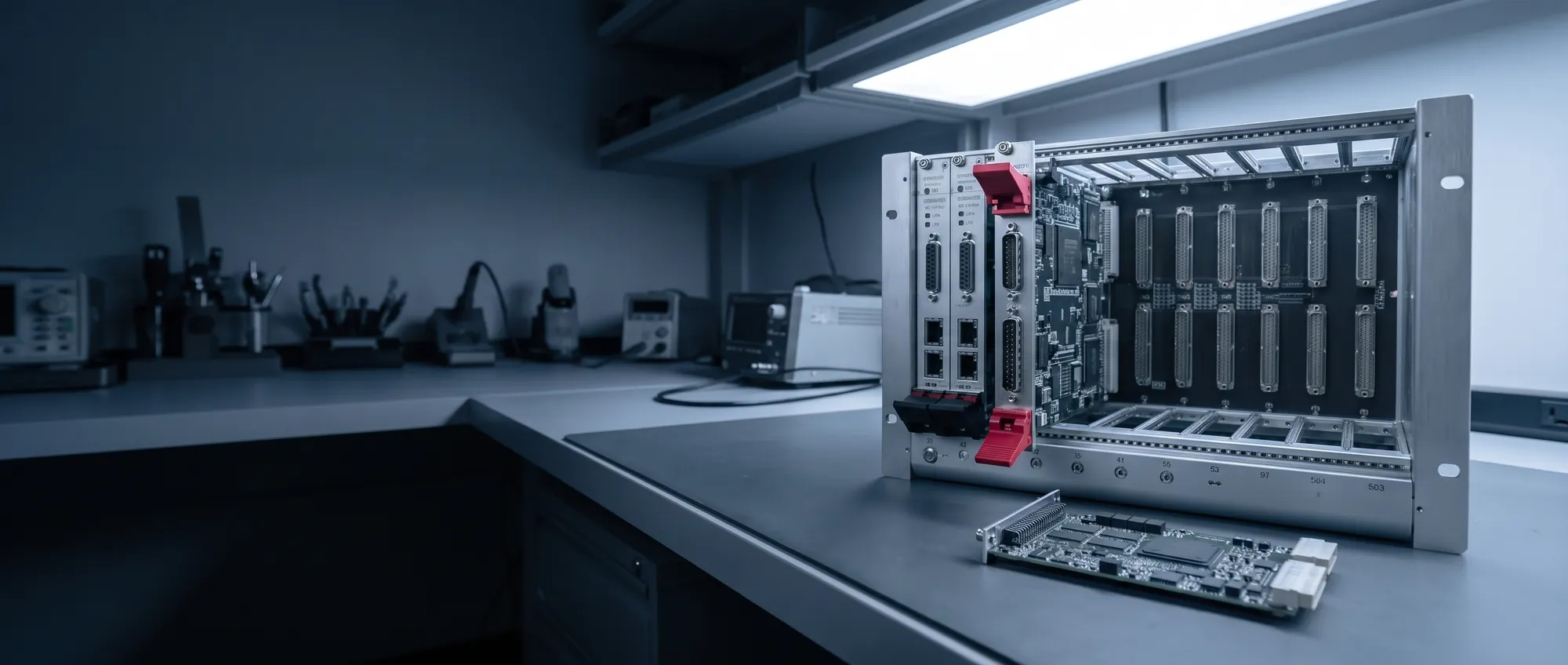
The CompactPCI architecture, explained
Desktop PCI, rethought for industry: 3U/6U Eurocard format, 2 mm pin-and-socket connectors, hot swap and up to 8 slots per segment. Here you find the standard, the PICMG 2.x family and the catalog.
What CompactPCI is: PCI in industrial form
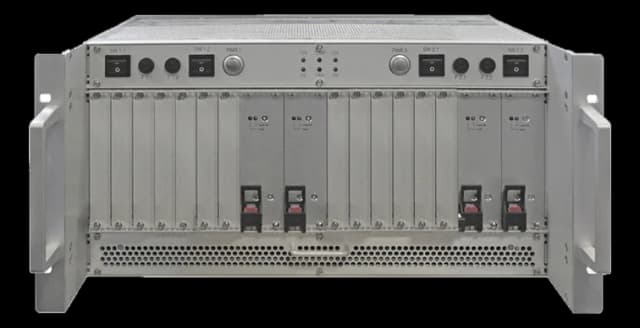
CompactPCI adapts the PCI specification to industrial applications that require a smaller, more robust mechanical form factor than the desktop: same electrical layer, Eurocard mechanics.
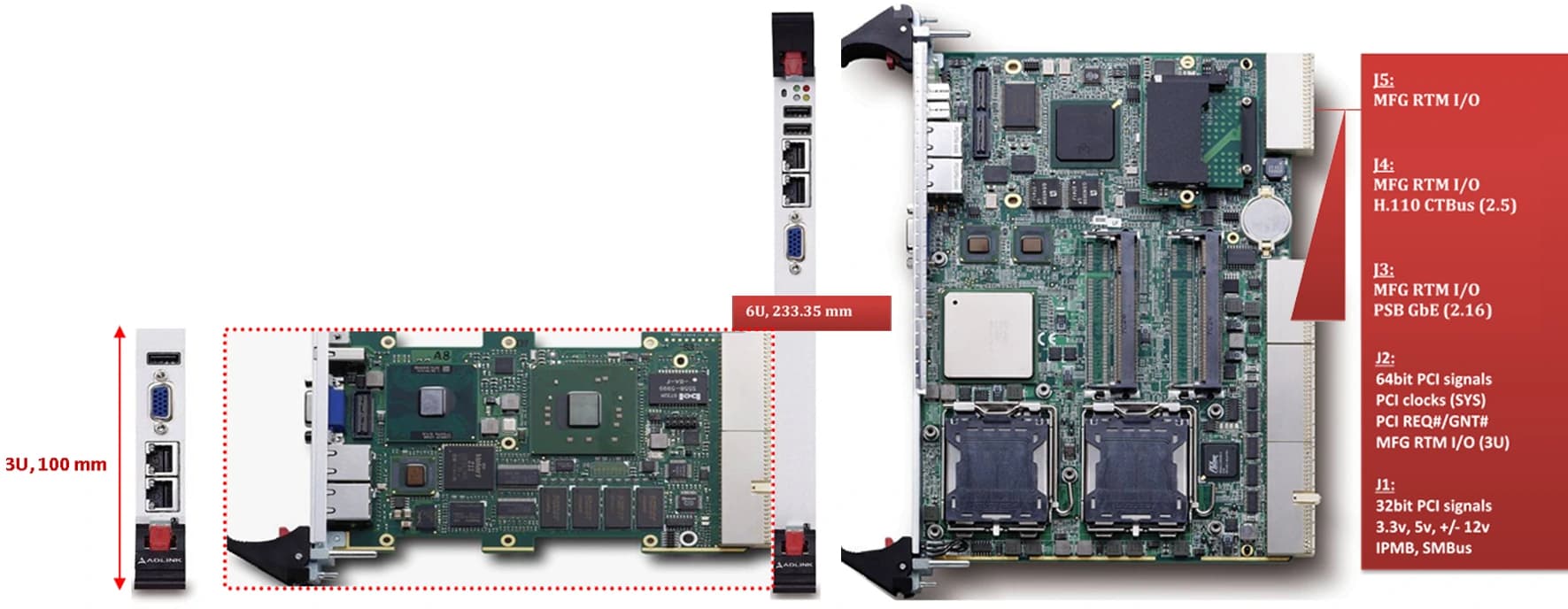
Boards mount vertically in a card cage, held by connector, guides and a screwed-in face plate: the 2 mm pin-and-socket connector (IEC 1076) is more reliable than the desktop card edge under shock and vibration. Compared to desktop PCI, CompactPCI doubles the slots — 8 versus 4 — and allows multiple bus segments with bridges; hot swap is in the specification, with staged pins for grounding on insertion.
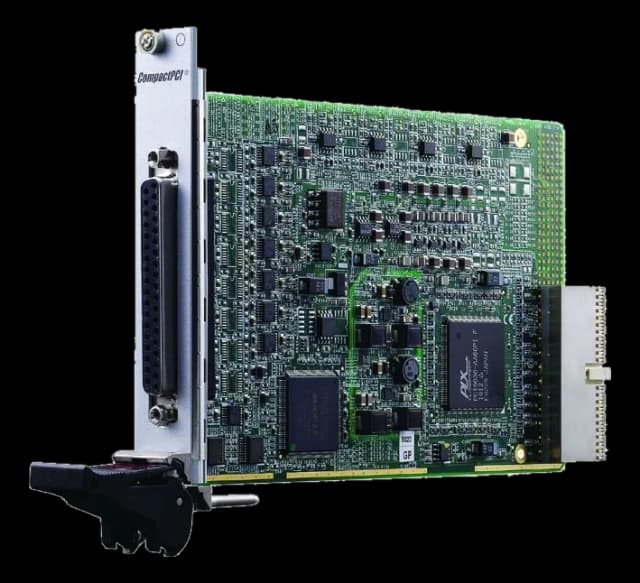
The architecture offers a wide choice of Intel and PowerPC single board computers in 3U and 6U and a complete range of I/O boards and modules: acquisition, fieldbus, avionics interfaces, Ethernet, serial. Ratified as PICMG 2.0 in 1995, it grew as the 2.x family — up to the 2.16 packet switching backplane, which brings switched Ethernet into the backplane.
The service: custom platforms and microracks How the engineering team works
What the specification says
The PICMG 2.x family, item by item
The core and the extensions that still matter: hot swap, Ethernet in the backplane, the bridge to serial.4 entries
PICMG 2.0
Core specification · 1995
The base: the PCI bus on a passive Eurocard backplane. On 3U a 220-pin connector (J1+J2) carries power and 32/64-bit PCI signals; 6U adds up to 315 pins for hybrid buses, 8-slot expansions and IEEE 1101.11 rear I/O.
PICMG 2.1
Hot swap
Replacement with the system running: slightly longer pins guarantee ground before signal contact, and ENUM# notifies the host. With the colored coding key — yellow 3.3 V, blue 5 V — the backplane declares its I/O voltage.
PICMG 2.16
Packet Switching Backplane
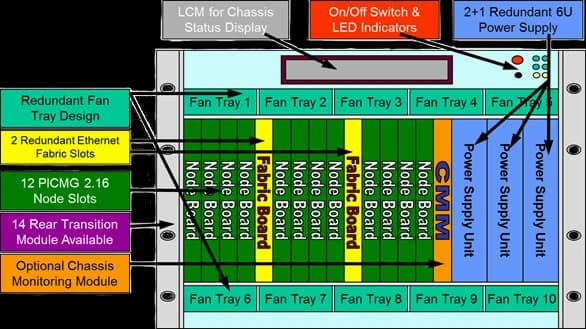
The industry's first switched-fabric Ethernet backplane architecture: node boards and fabric boards in a star topology (or dual star with two switches), 10/100/1000 full-duplex links, up to 19 nodes. IP clustering, redundancy and chassis failover without cables.
PICMG 2.30
CompactPCI PlusIO
The bridge to serial: PCIe, SATA, USB and Ethernet come out on J2 alongside classic PCI. It is the migration path that prepares CompactPCI Serial.
Classic and 2.16, in a table
What changes when Ethernet enters the backplane.1 tables
Classic cPCI vs PICMG 2.16
From the technical page's comparison table.
| Classic cPCI | cPCI PICMG 2.16 |
|---|---|
| PCI bus | Embedded-standard Ethernet with PCI |
| No Ethernet link on the backplane | 10/100/1000 Mbps Ethernet |
| IPMI over IPMB management | IPMI over LAN management |
| Proprietary RSS | IP clustering, RSS, chassis failover |
| 6U × 160 mm · 0.8″ pitch · 21 slots in 19″ | 6U × 160 mm · 0.8″ pitch · 21 slots in 19″ |
Where CompactPCI works
Machine control, transportation and defence: where the installed base still speaks PCI.
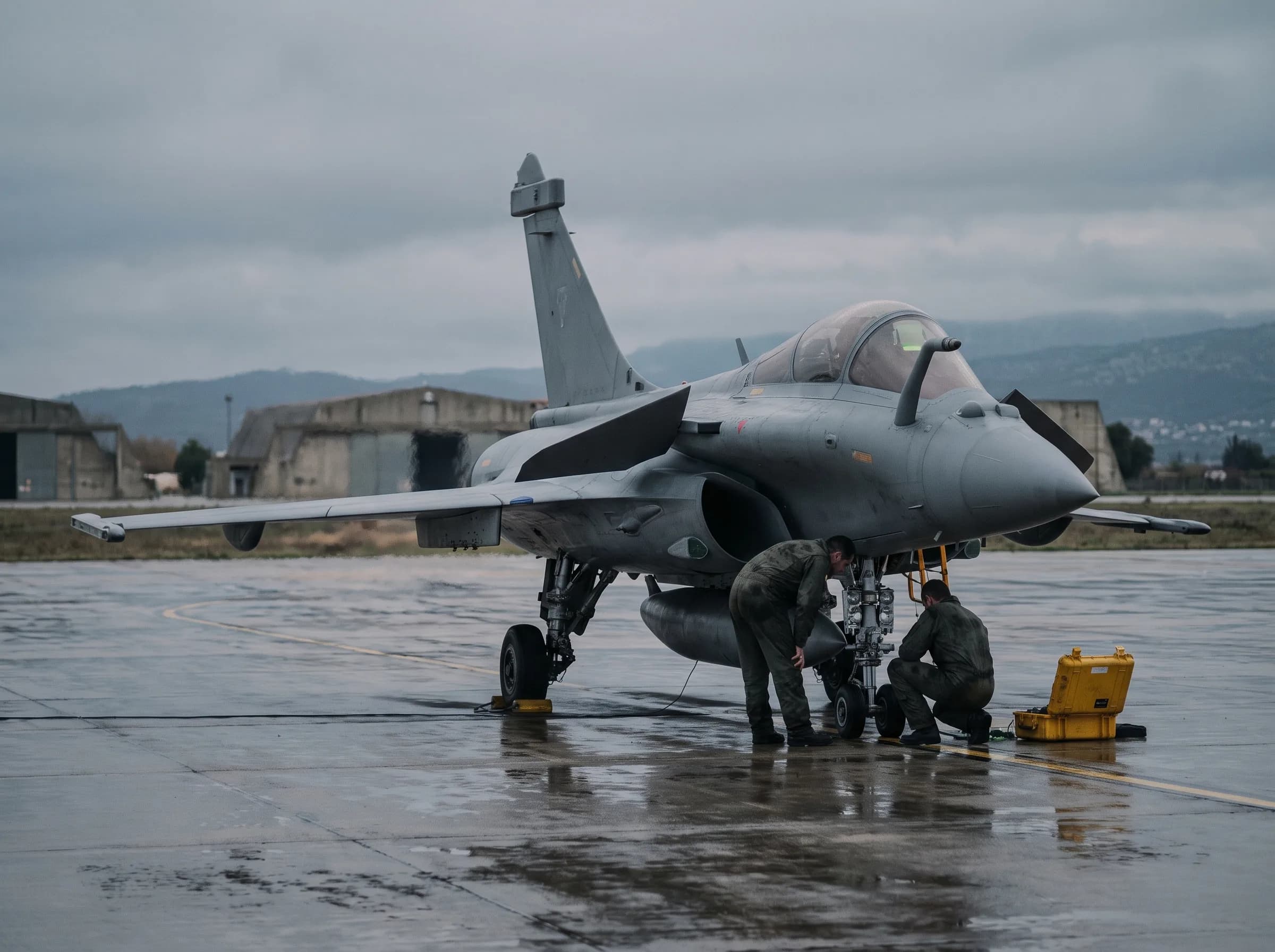
Aerospace & defense
Air, sea, land: avionics, bridge systems and qualified vehicle platforms.
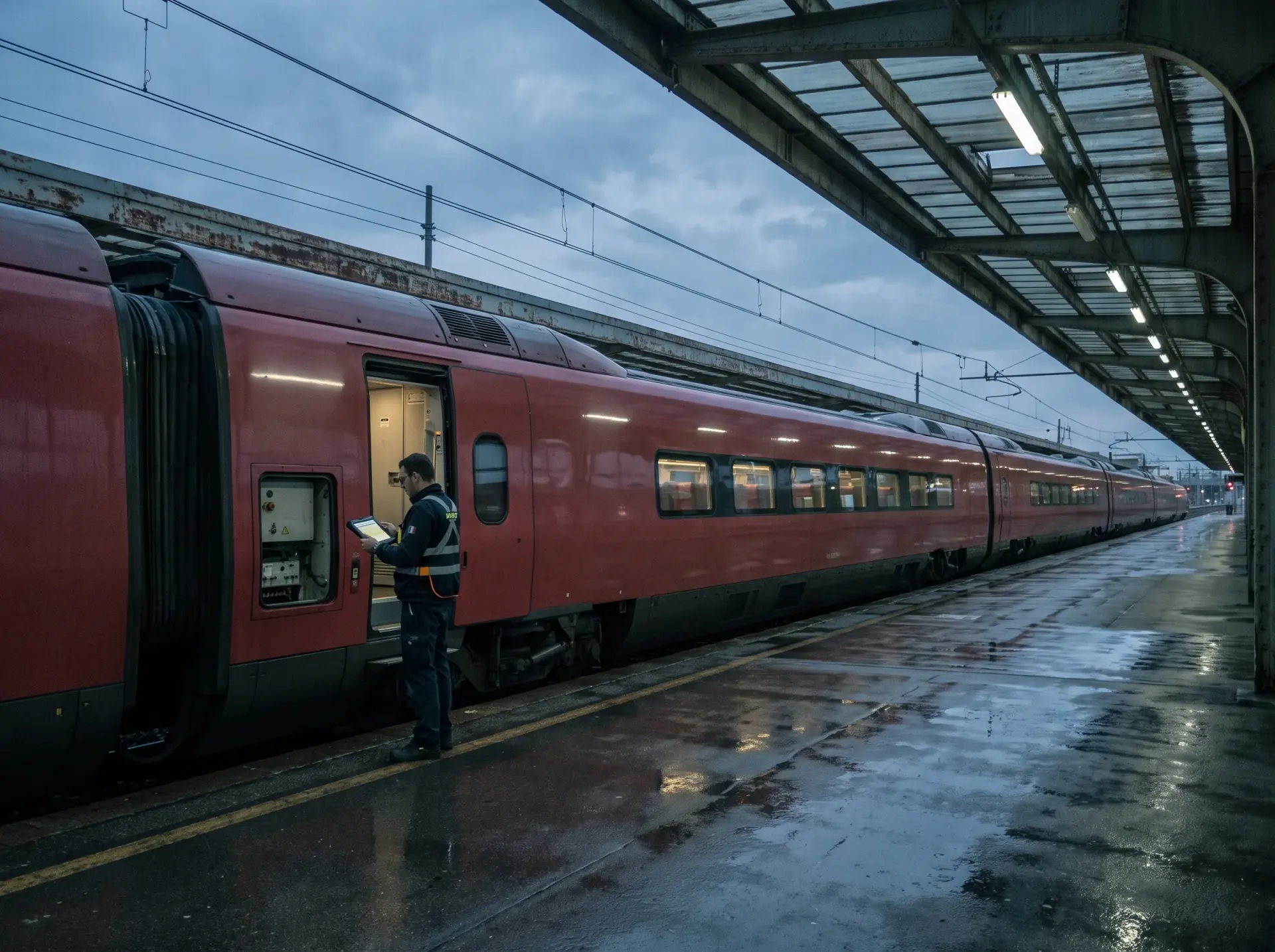
Transport & railway
Onboard train, signaling and vehicles.
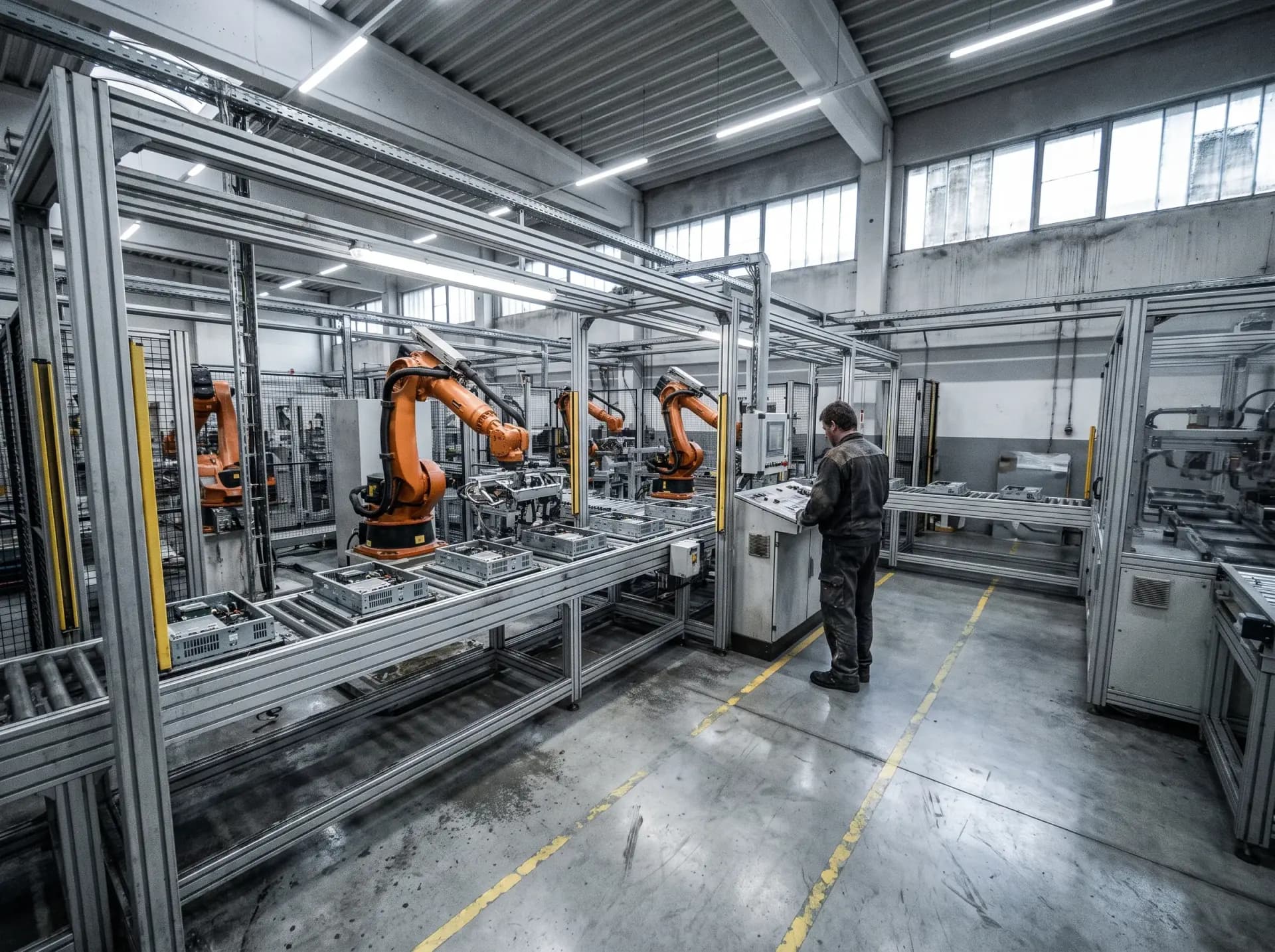
Industrial automation
Line control, robotic cells and machine-side HMIs.
3
markets served
Aerospace & defense, transport & railway, industrial automation: applications, references and qualifications.
All markets
Nearby architectures
The serial successor and the Eurocard cousins.

Let's talk about your project
Phone and email go straight to our technical sales team in Turin: the first answer is already a technical one.